Your business is outside the EU. Does the EU AI Act still apply to you, and what has the AI Omnibus changed?
The EU AI Act can apply to Singapore businesses with no EU office if their AI is sold into the EU or its output is used there. The AI Omnibus kept that reach but moved the high-risk deadlines to December 2027 and August 2028.
By EQX Corporate
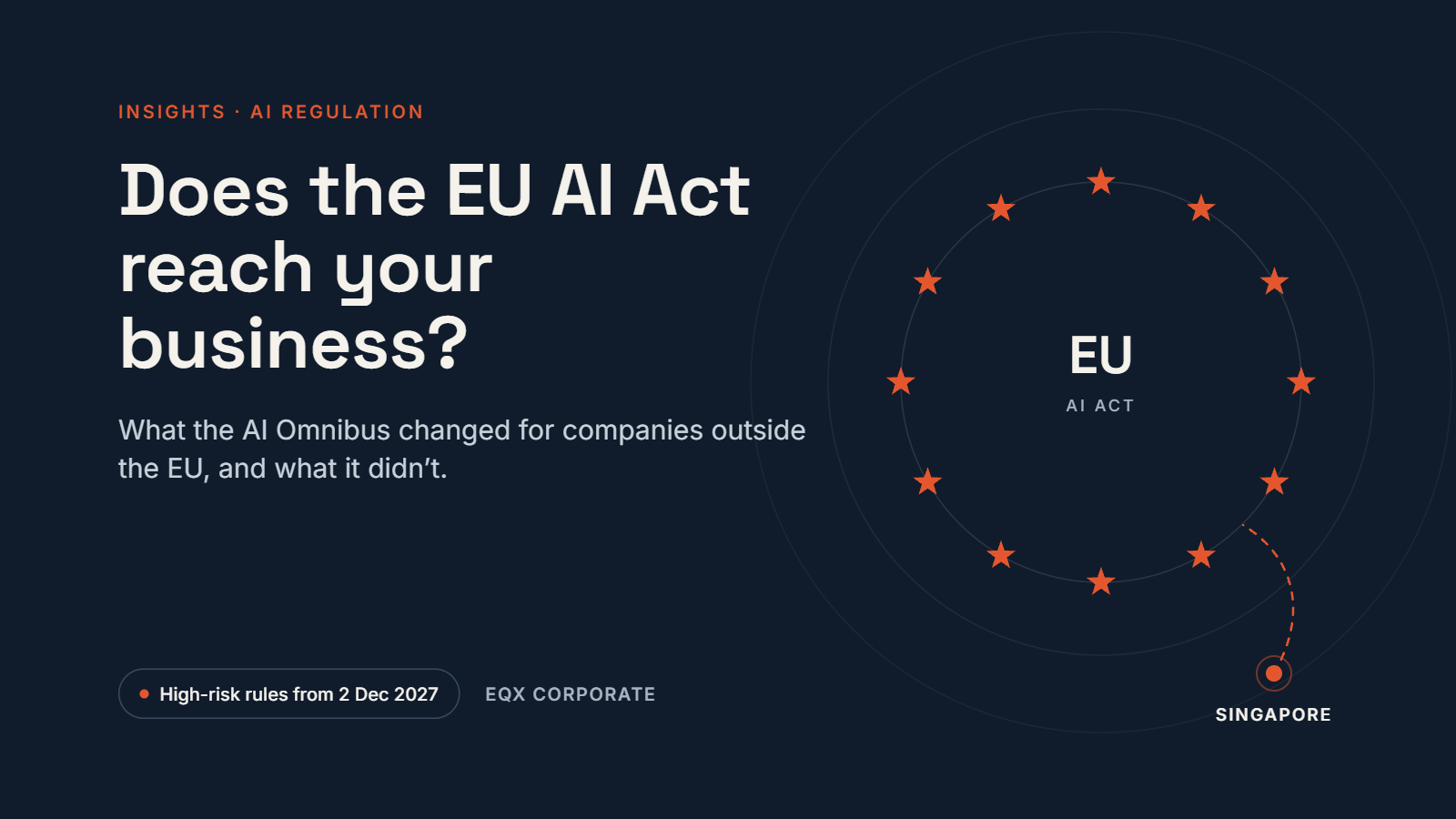
If your business is outside the European Union, the EU Artificial Intelligence Act may well still apply to you. The Act reaches businesses outside the EU if they sell or supply AI in the EU, or if the results their AI produces are used there.[1] A Singapore company with no office in Europe can therefore be caught.
The Digital Omnibus on AI (Regulation (EU) 2026/1744), which came into force on 27 July 2026, did not change that reach.[2][3] What it changed is timing and paperwork. The heaviest obligations, for "high-risk" AI such as AI used in hiring, lending or education, now start on 2 December 2027 instead of 2 August 2026. For AI built into regulated products, the date is now 2 August 2028.[3][4]
The Omnibus also added a new outright ban. AI tools that create non-consensual intimate images or child sexual abuse material are now prohibited, with fines of up to EUR 35 million or 7% of worldwide turnover.[3][10] For most Singapore businesses, though, the first contact with the EU AI Act will be a European customer's contract, not a European regulator. If you have customers, users or staff in Europe, now is the time to work out where you stand.
The EU AI Act in brief
The EU AI Act is Europe's law on artificial intelligence, Regulation (EU) 2024/1689.[11] It regulates AI according to how risky the use is.
At the top sits a short list of banned practices, which have been prohibited outright since 2 February 2025.[12] Below that are high-risk uses, such as screening job applicants, deciding who gets a loan or grading students. These carry heavy obligations covering risk management, documentation, testing and human oversight.[5]
A third tier covers transparency. Chatbots must tell people they are talking to AI, and AI-generated content must be marked as such.[6] Most other everyday uses of AI carry few or no specific obligations under the Act. Separate rules, in force since 2 August 2025, apply to providers of "general-purpose AI models", the large models that other AI products are built on.[12]
When the Act reaches companies outside the EU
The Act does not look at where your company is incorporated. It looks at where your AI goes, and it catches non-EU businesses in two main situations.[1]
The first is where you sell or supply AI into the EU. If you build an AI product and sell it, license it or make it available to customers in the EU, the Act treats you as a "provider", wherever you are based. The same applies if you offer a general-purpose AI model in the EU.[1]
The second situation surprises people. Your AI can run entirely on servers in Singapore, and you may never sell it in Europe. But if what it produces, whether a score, a recommendation, a decision or generated content, is used in the EU, the Act can still apply. It applies both to the business that built the AI and to a business that simply uses it.[1]
The Act also reaches importers, distributors and manufacturers that put AI into products sold in the EU. It does not apply to purely personal, non-professional use, or to AI developed solely for scientific research.[1] Having no EU office, in short, does not take you outside the Act.
Provider or deployer: why the label matters
The Act uses two main labels, and the label decides what you must do. A provider is the business that develops an AI system, or has it developed, and puts it out under its own name. Providers carry most of the obligations. A deployer is a business that uses an AI system in its work.
Resellers should watch for a trap. If you put your own name or brand on someone else's high-risk AI system, substantially modify it, or repurpose an ordinary AI tool for a high-risk use, the Act treats you as the provider.[7] White-labelling an AI hiring tool for European clients can therefore move the full provider burden onto you.
Are you likely to be caught?
A few common scenarios show how the rules play out, though the answer always depends on the facts. No EU court has yet ruled on how far the "output used in the EU" rule reaches.
If your HR software screens job applicants for an employer in Germany, you are very likely caught as the provider of a high-risk system. The software is sold into the EU, and employment screening is a listed high-risk use.[1][5] The same is very likely true if you use AI to assess the creditworthiness of applicants who live in the EU. The output is used in the EU, and credit scoring of individuals is also a listed high-risk use.[1][5]
If you resell another company's AI hiring tool to EU clients under your own brand, you are likely caught as the provider, because putting your name on a high-risk system makes it yours.[7] If you offer your own large AI model to developers in the EU, you are caught as the provider of a general-purpose AI model, and you will generally need an EU representative.[1][9]
An agency that uses AI to create realistic images or video for an EU client's campaign is possibly caught, mainly for transparency. The output is used in the EU, and deepfake-style content must be disclosed.[1][6] By contrast, if you use AI tools only internally, with no customers, users or staff in Europe, you are unlikely to be caught, since nothing is sold into the EU and no output is used there.[1]
What being caught means
What you must do depends on the risk level of what you do.
- Providers of high-risk AI need a compliance system covering risk management, data governance, technical documentation, human oversight, accuracy and security, plus a conformity assessment and registration. Without an EU establishment, they must appoint an authorised representative in the EU, by written mandate, before making the system available there.[8]
- Users (deployers) of high-risk AI must follow the provider's instructions, assign trained people to oversee the system, monitor it, keep its logs for at least six months, and tell affected workers and individuals that it is being used.[13]
- Providers of generative AI or chatbots must tell people when they are dealing with AI and mark AI-generated content in a machine-readable way.[6]
- Providers of general-purpose AI models based outside the EU must appoint an EU authorised representative, with a limited exemption for certain open-source models.[9]
The fines are significant. They reach up to EUR 35 million or 7% of worldwide annual turnover for banned practices, and up to EUR 15 million or 3% for most other breaches. Smaller businesses (SMEs) pay whichever of the two figures is lower.[10]
What the AI Omnibus changed
The AI Omnibus is a package of amendments to the AI Act. It is Regulation (EU) 2026/1744, adopted on 8 July 2026 and in force since 27 July 2026.[2][3]
New deadlines
The biggest change is to the timetable. High-risk AI listed in Annex III, which covers areas such as hiring, credit and education, was due to be regulated from 2 August 2026.[12] That date has moved to 2 December 2027. High-risk AI built into regulated products under Annex I moves from 2 August 2027 to 2 August 2028.[3][4]
The deadline for machine-readable marking of AI-generated content is still 2 August 2026 for new systems. Systems already on the market before that date have until 2 December 2026.[14]
A new ban
AI that generates non-consensual intimate imagery or child sexual abuse material was not specifically listed before; it is now banned.[3] The ban is reported to apply from 2 December 2026.[15][16]
Lighter obligations
Providers and deployers previously had to "ensure" a sufficient level of AI literacy among staff. They must now "take measures to support" it, while the Commission and Member States take a larger role.[3][2] Relief that previously applied only to SMEs now extends to "small mid-caps" (SMCs).[2][3] Businesses must still register AI systems they consider exempt from the high-risk rules, but the process has been simplified.[2][4] Supervision by the EU AI Office, previously focused mainly on general-purpose AI models, now extends to certain AI systems built on those models.[2][4]
What did not change
The Omnibus did not change who the Act covers. It amended other parts of Article 2, but not the paragraph that lists who is caught.[3] The categories of banned, high-risk and transparency uses also remain.[15]
For high-risk systems placed on the market before the new deadlines, the Omnibus clarifies the grace period. Broadly, they can stay on the market without fresh certification unless their design changes significantly.[3] The details matter, so check the wording before relying on it.
What this means for businesses in Singapore
EU law is foreign law and does not apply in Singapore as such. But it binds a Singapore business whose activities fall within Article 2 of the Act, and Singapore courts play no part in that question.
Singapore has taken a different path. The Government has said it "cannot adopt a one-size-fits-all approach" to regulating AI, and has relied on frameworks and sector-specific rules rather than a single AI law.[17] Its main tools are the Infocomm Media Development Authority's (IMDA) governance frameworks, sector rules and data protection law. In January 2026, IMDA launched the Model AI Governance Framework for Agentic AI.[18][19] These frameworks are guidance, not an AI statute on the EU model.
On harmful AI imagery, Singapore's Online Safety Commission can already act on AI-generated intimate image abuse and image-based child abuse under the Online Safety (Relief and Accountability) Act.[20] That is a relief mechanism for victims, not a ban on the tools themselves, so it works quite differently from the new EU prohibition.
Three practical points follow for a Singapore business with European exposure:
- The EU rules may be the strictest you face. Build your AI governance to the EU standard where you have EU exposure, using IMDA's frameworks as the base.
- Contracts will arrive first. European customers who are deployers have their own obligations, and will push AI Act warranties, documentation duties and audit rights down to their suppliers. Expect those questions even if you do not sell in Europe directly.
- One governance programme is better than two. An AI inventory, risk classification and documentation serve both the EU Act and Singapore's frameworks.
What to do now
- List your AI. Record every AI tool you build, sell or use, and who uses its output.
- Map your EU exposure. Mark which tools are sold to EU customers, used by EU staff, or produce results used in the EU.
- Name your role. For each tool, decide whether you are a provider or a deployer, and check whether rebranding or modification has made you a provider.
- Classify the risk. Check each tool against the banned list and the high-risk list, which covers hiring, credit, education, insurance and other areas.[5]
- Act now on the new ban. If you offer image or video generation, put safeguards in place against intimate and abusive content before the ban applies.
- Label AI content. If you provide generative AI, plan machine-readable marking. The extra time to 2 December 2026 applies only to systems already on the EU market before 2 August 2026.[14]
- Plan backwards from 2 December 2027. High-risk providers need time for documentation, testing, conformity assessment and an EU representative. Do not assume further delay.
- Prepare for contract negotiations. Decide in advance which AI Act warranties, information rights and liability caps you can accept.
- Train your people. The AI literacy duty is softer than before, but it still applies.[3]
What is still unclear
Several questions remain open. The detailed European technical standards that high-risk systems will be tested against are not yet finished, though the Commission has a fallback power to issue its own specifications.[15] If the standards are late, pressure to move the deadlines again may return, but there is no legal basis to assume it.
It is also unclear how the SME and small mid-cap relief applies to groups based outside the EU. The Omnibus defines small mid-caps by reference to an EU recommendation.[3][21] Finally, no court has yet tested how far the "output used in the EU" rule extends, for example to AI output that reaches the EU only incidentally.
This article is general information, not legal advice. It reflects the position as at 29 September 2026. For advice on your circumstances, contact EQX Corporate at [contact details].
This article is general information, not legal advice. Speak to us about your company’s circumstances.
Need help applying this?
Tell us about your company and what you need. We reply within one business day.